Foundation Excavation in Kelowna & the Okanagan Valley
Precise digging, shoring and slope work built for our variable soils
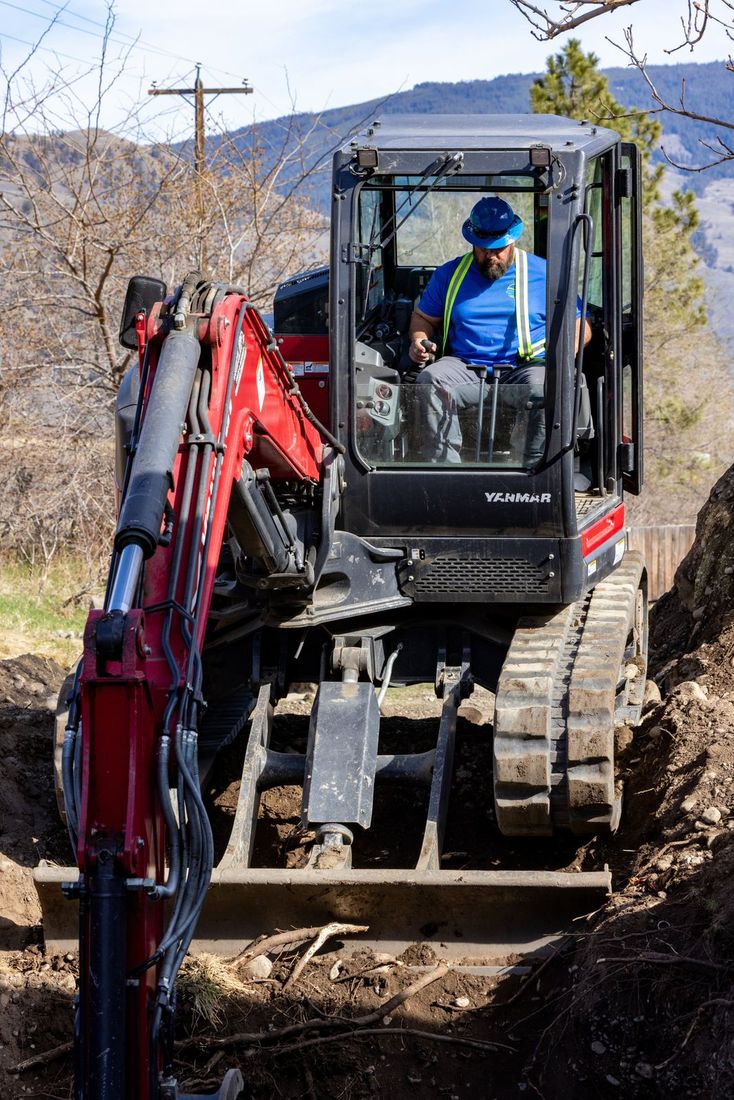
The foundation is the one part of a building you really can’t afford to get wrong, and in the Okanagan the ground under it is rarely the same twice. You might be cutting a basement into a gravelly East Kelowna bench one week and wrestling with compressible lakebed silt near the Vernon bluffs the next. Add hillside lots that overlook the lake, swelling clays in the North Okanagan, and dense glacial till that fights every bucket in Lake Country, and you start to see why foundation excavation here is a job for someone who knows the local dirt.
At GroundStone Excavating, foundation digs are core work, and we treat the variability of Okanagan soils with the respect it demands. Here are the questions builders and homeowners ask us most.
What does foundation excavation involve?
It’s a careful sequence, not just a hole. On a typical job we:
- Arrange locates and lay out the dig to the engineered drawings, so we cut the exact footprint, depth and elevations specified.
- Strip to undisturbed soil, removing topsoil, loose fill and any soft material so footings bear on firm native ground.
- Manage the slopes or shoring, sloping the cut back or shoring it to keep the excavation safe and stable.
- Deal with water where it shows up, intercepting seepage or perched water so the crew works in a stable hole.
- Trim to grade and hand off clean, leaving room for footings and the perimeter drain and rough-grading for the next trade.
How deep does a foundation need to be here?
It depends on what you’re building and on the engineering, but frost sets the floor. Even with our hot summers, Okanagan winters are cold, and the BC Building Code (following the National Building Code) requires footings to sit below the frost line on undisturbed soil. A full basement, once you add the footing depth, is commonly a nine- or ten-foot dig. We hit the depths and bearing elevations your engineer specifies exactly — because in our variable soils, a footing that bears on the wrong layer is a problem you do not want under your house.
Our soils are so variable. Why does that matter for a foundation?
Because the soil is what actually holds your house up, and in the Okanagan it changes from lot to lot and even within a single lot. Local geotechnical experience lays it out clearly: valley-bottom Kelowna sits on compressible lacustrine silts and clays that can settle under a building’s weight; Vernon and the North Okanagan have widespread silt bluffs and swelling clays that move with moisture; Lake Country shifts from dense till to lakeshore silt over a short distance; and Penticton’s loose alluvial sands and gravels can settle or, in floodplain zones, even liquefy in an earthquake. That’s why a geotechnical investigation is so valuable here, and why the excavation has to be matched to what the soil actually is. On the tricky soils, engineers sometimes call for helical piles or other deep support to bypass the weak layer entirely.
What about hillside lots and slope stability?
A lot of the best Okanagan view lots are on slopes — and slopes are where foundation excavation gets serious. Cutting into a hillside of colluvium, fractured bedrock or silt can ravel or fail if it’s not done with care, and placing a new load near the crest of a slope can set off instability. On these sites we work to a geotechnical engineer’s slope-stability analysis, keep cuts at safe angles, and coordinate any shoring or retaining that’s required. The same care carries over from earlier site preparation on a sloped lot. It’s also a WorkSafeBC safety matter: any excavation deep enough to put a person below grade has to be properly sloped or shored, full stop.
Is groundwater a problem in Okanagan foundation digs?
Not the constant high water table you’d fight on the wet coast — but don’t assume the hole will stay dry. Hillside lots around Kelowna and Lake Country often have perched water tables, seasonal seepage and even springs that show up partway down a cut, and those wet zones weaken the soil and have to be managed. Where we hit them, we intercept and pump the water so the footings go in on stable ground rather than into a seep. Reading where water hides in our layered soils is part of doing the dig right — and it ties directly into the drainage and perimeter system that protects the finished foundation.
Do I need a permit, an engineer, and what about backfill?
For a new foundation, yes — building permits and engineered drawings are part of the process, your designer or builder usually leads that, and on our variable ground a geotechnical report is often money well spent. Soil removal and deposit can also fall under local bylaws such as the City of Kelowna’s Soil Removal and Deposit Bylaw No. 9612. Once the foundation is in, backfill matters just as much as the dig: we backfill in compacted lifts with suitable material, avoid packing swelling clay against the wall, and grade the finished surface to slope away from the building so water sheds off instead of soaking down against the foundation.
Why GroundStone Excavating?
A foundation is the one thing you can’t cheaply fix after the fact, and Okanagan soils give you every chance to get it wrong. We know how this valley’s ground behaves — the gravelly benches, the compressible silts, the swelling clays, the touchy hillsides — and we dig clean and precise to your engineered specs, managing the slopes, water and backfill so your concrete crew inherits a stable, ready hole. Residential or commercial, valley floor or view lot, we’ll get the dig right the first time.
Building in the Okanagan? Start with a foundation dig done right.
Book a free, no-pressure on-site estimate for residential or commercial foundation excavation in Kelowna, West Kelowna, Penticton, Lake Country, Vernon and across the Okanagan, or explore the rest of what we do to see how the pieces fit together.