Utility Trenching in Kelowna & the Okanagan Valley
Water, sewer, power and irrigation lines dug safely through our soils and rock
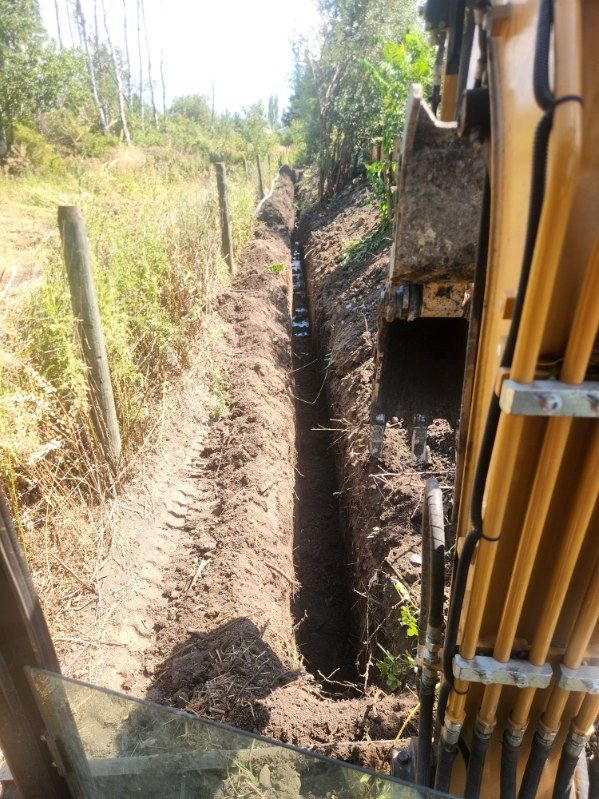
Trenching looks like the simplest job on a site — dig a line, drop in the pipe or conduit, fill it back. Anyone who’s actually done it in the Okanagan knows better. Out here the trench can go from easy to maddening in the span of a single backyard: clean sand and gravel that the bucket slices through, then a seam of cobbles and boulders that stops you cold, then a stretch of fine silt that won’t hold a vertical wall for five minutes. Whether it’s a water line to a new home in West Kelowna, power and irrigation out to a Lake Country orchard, or a sewer connection in Penticton, the ground decides how the day goes.
At GroundStone Excavating we run utility trenching across the Central and North Okanagan, and we plan for our soils instead of being surprised by them. Here’s what people most want to know.
What kinds of utility trenching do you do?
Pretty much any buried service line a residential or commercial property needs:
- Water service lines from the main to the home, shop or suite.
- Sewer and septic lines, including connections and replacements.
- Electrical, gas and communications conduit for new builds, additions and detached shops.
- Irrigation mains for orchards, vineyards, acreages and landscaped properties.
- Drainage and stormwater piping tied into the rest of a site’s water management.
Is our sandy, gravelly soil easy to trench?
Easy to dig, yes — risky to stand in, sometimes. The coarse glaciofluvial sand and gravel that covers a lot of the valley cuts quickly, which is great for productivity. The catch is that loose granular soil has almost no cohesion: a clean vertical trench wall in dry sand can collapse without any warning at all. That’s a serious hazard the moment anyone has to get down into the trench. So while the digging is fast, the safety planning has to be just as serious as it is in any other ground — often more so. We slope the walls back or use trench shoring and boxes as required, because a cave-in in “easy” soil is just as dangerous as one in clay.
What about rock, cobbles and hardpan?
This is the other half of the Okanagan trenching story. Those same glacial deposits are full of cobbles and boulders, and on the hillsides around Kelowna and Lake Country you can hit dense glacial till or even fractured bedrock not far down. When that happens the job slows and the equipment changes — we may bring in a rock hammer or heavier machine to get through. The honest part of a good quote is accounting for the possibility of rock before we start, so a hard seam doesn’t turn into a surprise change order. We’d rather tell you up front that your bench lot might have rock than discover it for you halfway down.
How deep do trenches need to be here?
Depth depends on what’s in the trench and on frost. Even though the Okanagan is hot in summer, winters get cold and the frost line still matters — water and other freeze-sensitive lines have to sit deep enough that they won’t freeze and burst, which generally means well below grade. Sewer and drainage lines need consistent depth and slope to flow properly. Electrical and gas have their own cover requirements. We dig to the depth each service and the applicable codes call for, rather than the bare minimum that looks fine until the first hard freeze.
Why does locating matter so much on rural properties?
Because the Okanagan is full of acreages, orchards and vineyards with decades of private lines running every which way — old irrigation, a power feed to a pump house, a line to a barn nobody’s thought about in years. Public utilities get marked through BC 1 Call (the free Click Before You Dig service, which needs about three business days), and that’s non-negotiable on every job. But on a working farm property the private lines that aren’t in any database are just as easy to hit, so we take the time to identify them with the owner before we trench. Cutting an irrigation main in the middle of a dry Okanagan summer is not a mistake anyone wants to make.
How do you backfill so the trench doesn’t settle?
A trench that’s backfilled carelessly will sink, and a settled trench across your new driveway or yard is an annoyance for years. The pipe gets the right bedding material around it so it’s properly supported and protected — you don’t want sharp cobbles bearing directly on a water line. Then we backfill in compacted lifts rather than shoving everything back in one go. In coarse gravelly soil that compacts well this goes smoothly; in silt we’re more careful about moisture. It’s the same compaction discipline that keeps a site-prepped pad from settling. The goal is simple: the ground over the trench should end up as solid as the ground around it.
Do I need a permit for utility trenching?
Usually some part of the work does. Sewer and water connections, electrical and gas all have permitting and inspection requirements through the municipality and the relevant authorities, and your trade contractors typically pull those. Soil deposit and removal can come into play on larger jobs under local bylaws like the City of Kelowna’s Soil Removal and Deposit Bylaw No. 9612. And again, every dig needs locates first. We coordinate the excavation side so it lines up with the inspections and keeps your project moving.
Why GroundStone Excavating?
A buried line is only as good as the trench it sits in. We know how to read Okanagan ground — where it’ll cut like butter, where it’ll collapse, and where the rock is hiding — so we dig safely, protect what’s already in the ground, bed and backfill properly, and leave you with services that work and a yard that doesn’t sink. Residential or commercial, in town or out on the acreage, we’ll trench it right.
Need a line in the ground? Let’s trench it safely and properly.
Book a free, no-pressure on-site estimate for residential or commercial utility trenching in Kelowna, West Kelowna, Penticton, Lake Country, Vernon and across the Okanagan, or explore the rest of what we do to see how the pieces fit together.